The B2B Sales Tech Stack That Actually Works: How to Build an Outbound System in 2026
AI GTM
B2B Sales Tech Stack: Build a Working Outbound System
Build a B2B sales tech stack that compounds results. 6-layer system architecture for outbound in 2026. 15-25% reply rates vs 3-5% generic.
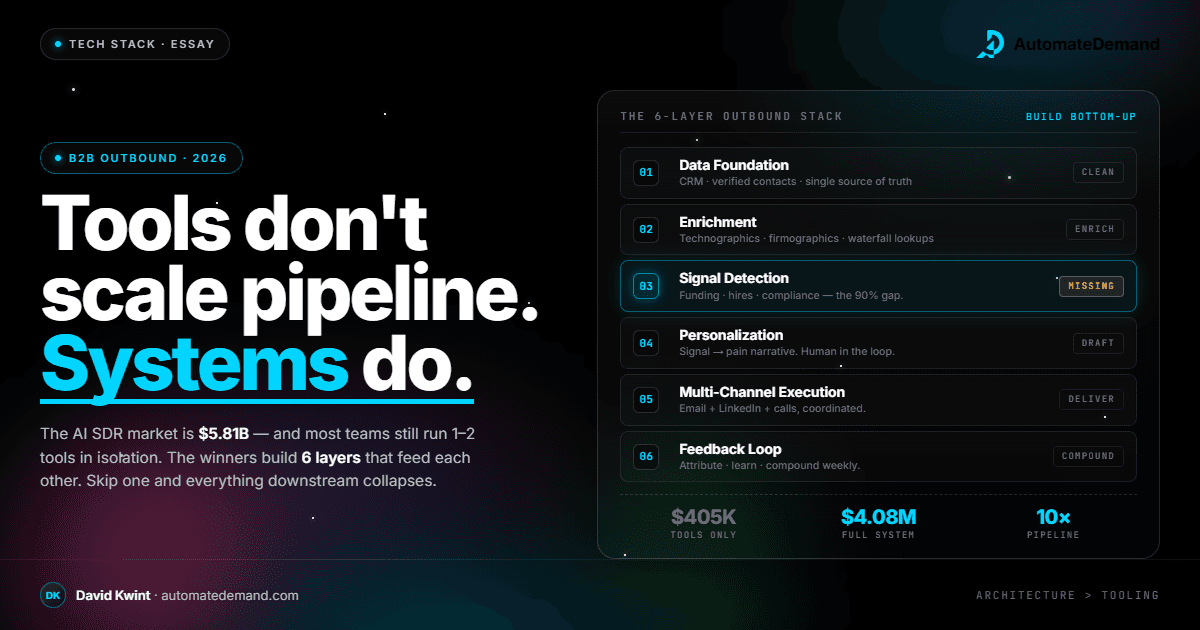
A successful B2B sales tech stack requires a six-layer architecture: data foundation, enrichment, signal detection, personalization, multi-channel execution, and a feedback loop. Rather than buying isolated tools, teams must build a system where each layer feeds the next. This architectural approach generates 15-25% reply rates by prioritizing timing and relevance over raw outreach volume.
Key Takeaways
A functional sales tech stack must be built sequentially from a clean data foundation up to a measurement feedback loop.
Signal-based outreach generates reply rates of 15-25%, significantly outperforming the 3-5% industry average for generic campaigns.
Successful AI implementation requires a human-in-the-loop approach to ensure personalization reads as authentic rather than machine-generated.
The B2B Sales Tech Stack That Actually Works: How to Build an Outbound System in 2026
The AI SDR market hit $5.81 billion in 2026. Growing at 32.3% CAGR. And 1 in 3 field sales teams still use zero AI tools.
Here's the thing: the teams that do use AI mostly run 1-2 surface-level tools. A writing assistant here. A sequencing tool there. No system. No architecture. No compounding.
The difference between a B2B sales tech stack that generates pipeline and one that burns budget is not which tools you pick. It's whether those tools form a system or sit in isolation. Most teams buy tools for personalization and execution while ignoring the data, enrichment, and signal layers that make personalization actually work.
This is the system architecture guide I wish someone had given me three years ago. Six layers. Each one builds on the last. Skip a layer and the whole thing collapses.
Why Most B2B Sales Tech Stacks Fail Before They Start
The typical buying pattern looks like this: a VP of Sales sees a demo for an AI writing tool, buys it, plugs it into the existing CRM, and expects reply rates to double. They don't.
The math is simple. If your data layer feeds garbage contacts into a brilliant personalization engine, you get beautifully written emails sent to the wrong people. Or worse, to the right people at the wrong time.
A Futurum Q1 2026 survey found that 39% of enterprises expect GenAI delivered through task-automating agents. Not standalone tools. Agents that connect to systems.
Multi-channel outreach delivers a 287% lift over single-channel approaches. But multi-channel without clean data and real buying signals just means you're annoying prospects in three places instead of one.
The fix is architectural. Build from the bottom up.
The 6-Layer B2B Sales Tech Stack Architecture
Think of your outbound sales tools as a stack, not a shopping list. Each layer feeds the next. The output of Layer 1 becomes the input of Layer 2. Break the chain anywhere and everything downstream degrades.
Here's the architecture that produces 15-25% reply rates instead of the 3-5% industry average.
Layer 1: The Data Foundation
Every outbound system starts with data. Not "we have a list" data. Clean, structured, verified data with the fields you actually need for targeting.
What this layer does:
Sources accounts from multiple providers (Apollo, Crustdata, PeopleDataLabs)
Deduplicates and normalizes company records
Verifies contact information (email deliverability, phone accuracy)
Maintains a single source of truth in your CRM
Tool categories: CRM (HubSpot, Salesforce), data providers (Apollo, Cognism, ZoomInfo), verification tools (ZeroBounce, NeverBounce).
The mistake: Most teams skip verification entirely. They import 10,000 leads from a data provider and blast them. Bounce rates spike. Domain reputation tanks. Deliverability craters. The math on this is brutal. A 10% bounce rate can destroy six months of domain warming in a single campaign.
Without a clean data foundation, your entire sales technology stack is built on sand.
Layer 2: The Enrichment Layer
Raw contact data tells you who someone is. Enriched data tells you what they care about.
What this layer does:
Appends technographic data (what tools they use)
Adds firmographic depth (revenue, headcount growth, funding stage)
Pulls hiring signals (new VP Sales = 90-day mandate)
Detects tech stack changes (installed a competitor, dropped a vendor)
Tool categories: Enrichment platforms (Clay, Clearbit), technographic providers (BuiltWith, Wappalyzer), funding databases (Crunchbase, PitchBook).
The sweet spot is layering 3-4 enrichment sources per account. One provider gives you firmographics. Another gives tech stack. A third reveals hiring patterns. The combination creates a targeting profile no single tool can match.
This is where agentic GTM systems start to shine. Instead of manually enriching records, AI agents waterfall through providers automatically. Try source A. If it fails, try source B. Stop when the data is complete.
Layer 3: Signal Detection (Where 90% of Teams Drop the Ball)
This is the layer that separates top performers from everyone else. And almost nobody builds it.
Enrichment tells you about a company. Signals tell you about timing. Timing is everything in outbound.
What this layer does:
Monitors job postings for buying-intent keywords
Tracks funding rounds and executive changes
Detects compliance pressure (regulatory deadlines, audit findings)
Identifies expansion signals (new offices, market entries)
Scores accounts by signal density and recency
Tool categories: Intent data (Bombora, G2), social listening (Trigify, Brandwatch), news monitoring, custom scrapers.
The math is: signal-personalized outreach generates 15-25% reply rates. Generic outreach hits 3-5%. That's a 3-5x multiplier from a single architectural layer.
A company that just raised a Series B has an 18-month growth mandate. A company that just hired a VP of Sales has a 90-day pipeline target. A company facing a GDPR audit deadline has a compliance budget that needs spending. These are buying signals. Not firmographic checkboxes.
If you want to go deeper on this, signal-based outbound is the single biggest multiplier for B2B outbound in 2026.
Key takeaway: The gap between 3% and 20% reply rates is not better copy. It's better signal detection feeding that copy.
Layer 4: The Personalization Layer
Now you have clean data (Layer 1), enriched profiles (Layer 2), and real-time buying signals (Layer 3). This is where personalization becomes possible. Real personalization. Not "Hi {{first_name}}, I saw {{company_name}} is growing."
What this layer does:
Maps signals to pain narratives (funding round = growth pressure = pipeline gap)
Generates 1:1 message variations tied to specific signals
Matches tone and angle to persona (CFO gets ROI math, VP Sales gets pipeline velocity)
Creates multi-step sequences where each step adds a new angle
Tool categories: AI writing assistants (Claude, GPT-4), personalization engines, template builders within your sequencing tools.
The critical nuance: buyers now detect AI-generated outreach and actively filter it. The Gartner 2025 B2B Buying Survey confirmed that generic AI-written emails get worse results than well-crafted human templates. The AI layer needs to produce output that reads like a human who did their homework. Not like a language model that scraped a LinkedIn profile.
This is exactly why autonomous AI SDR models are failing. You can't remove the human from the system entirely. You can remove the grunt work. The thinking still matters.
Key takeaway: Personalization without signals is just mail merge with extra steps. Signals without personalization is wasted intelligence. You need both.
Layer 5: Multi-Channel Execution
With personalized, signal-driven messages ready, you need to deliver them across the channels where your buyers actually respond.
What this layer does:
Orchestrates email sequences with proper deliverability hygiene
Coordinates LinkedIn touchpoints (connection requests, DMs, comments)
Manages send volumes and cadence across channels
Handles domain rotation and warmup
Tool categories: Email sequencing (Instantly, Smartlead, Lemlist), LinkedIn automation (HeyReach, Expandi), multi-channel orchestrators (LaGrowthMachine).
The numbers: multi-channel outreach produces a 287% lift over email-only campaigns. But "multi-channel" means coordinated touches across platforms. Not sending the same message on email and LinkedIn simultaneously.
A working cadence looks like this:
Day | Channel | Action |
|---|---|---|
1 | Signal-based opener with value offer | |
3 | View profile, engage with recent post | |
5 | Follow-up with different angle | |
8 | Connection request with personalized note | |
12 | Breakup with lower-ask CTA |
The execution layer is where most teams start their B2B sales tech stack investment. That's the problem. Without Layers 1-3, you're executing beautifully into a void.
Automation tools at this layer reclaim 5-10 hours weekly per account manager. That time should flow back into signal research and account strategy. Not into sending more volume.
Layer 6: Measurement and Feedback Loop
The layer that makes the whole system compound over time. Without it, you're running campaigns. With it, you're building a learning machine.
What this layer does:
Tracks reply rates, positive reply rates, and meeting rates by signal type
Attributes pipeline to specific signals, offers, and messaging angles
Identifies which ICP segments convert and which don't
Feeds winning patterns back into Layers 3-4
Tool categories: CRM analytics, lead scoring models, attribution tools, custom dashboards.
The feedback loop in practice:
Campaign A targets companies with recent funding (signal) and offers a pipeline audit (value gift). Reply rate: 18%.
Campaign B targets the same companies with a generic "let's chat" CTA. Reply rate: 4%.
The system learns: funding signal + value gift CTA = high performer. It prioritizes this combination in future campaigns.
Top performers in B2B outbound hit 10%+ cold email reply rates consistently. They don't get there through better writing. They get there through better cold email strategy that compounds learning across every campaign.
Key takeaway: A system without a feedback loop is just a workflow. A system with one is a compounding asset.
The ROI Math: System vs. Isolated Tools
Let's run the numbers on a team of 3 SDRs over 12 months.
Isolated tools approach (Layers 4-5 only):
5,000 emails/month per SDR = 15,000 emails/month
3% reply rate (generic) = 450 replies
20% positive reply rate = 90 meetings/month
15% close rate at $30K ACV = $405K annual pipeline
Full 6-layer system:
3,000 emails/month per SDR = 9,000 emails/month (lower volume, higher quality)
18% reply rate (signal-driven) = 1,620 replies
35% positive reply rate = 567 meetings/month
20% close rate at $30K ACV = $4.08M annual pipeline
That's a 10x difference. With 40% fewer emails sent. The system approach sends less, converts more, and protects domain reputation in the process.
The tool cost difference between these two approaches is negligible. Maybe $500-800/month more for enrichment and signal tools. The architectural difference is everything.
How to Build Your B2B Sales Tech Stack (Practical Sequence)
Don't buy all six layers at once. Build sequentially. Each layer should be working before you invest in the next.
Month 1-2: Lock down Layers 1-2. Get your CRM clean. Pick 2-3 data providers. Build enrichment workflows. Verify every contact before it enters a sequence.
Month 3-4: Build Layer 3. Start with 2-3 signal types that matter for your ICP. Hiring signals and funding rounds are the easiest to detect. Build monitoring workflows that surface these weekly.
Month 5-6: Layer 4-5 simultaneously. Now invest in AI sales tools for personalization and multi-channel execution. Your signal data will make the AI output dramatically better than it would have been without Layers 1-3.
Month 7+: Layer 6 and compound. Build attribution. Track what works. Feed it back. This is where the SDR automation tools start paying for themselves many times over.
The 2026 B2B Sales Tools Landscape: What Changed
Three shifts define the 2026 sales technology stack market.
Shift 1: From tools to systems. The winners aren't selling point solutions. They're selling orchestration layers. Clay, for example, isn't a data tool. It's a workflow engine that connects dozens of data sources into enrichment chains.
Shift 2: From autonomous AI to human-in-the-loop AI. The "replace your SDRs with AI" pitch peaked in 2025 and crashed. The models that work keep humans in the loop for strategy and judgment while automating research, enrichment, and first-draft generation.
Shift 3: From volume to signal density. HubSpot data shows 15%+ tech/software industry concentration in their platform with 82% LinkedIn match rates. The data infrastructure exists to be precise. Teams that still spray 50,000 emails/month are competing with teams that send 5,000 highly targeted ones.
Among teams that use AI, most still run just 1-2 surface-level tools. The opportunity is in building the full stack.
FAQ: B2B Sales Tech Stack Questions
What tools do SDR teams need in 2026?
SDR teams need tools across all six layers: a CRM for data management, enrichment providers for account intelligence, signal detection tools for timing, AI for personalization, multi-channel sequencers for execution, and analytics for the feedback loop. The specific vendors matter less than the architecture. A cheap tool at every layer beats an expensive tool at one layer.
What is the best B2B sales tech stack?
The best B2B sales tech stack is one where every layer feeds the next. There is no universal "best" vendor list. The architecture matters more than the brand names. That said, most high-performing stacks in 2026 include a CRM (HubSpot or Salesforce), an enrichment orchestrator (Clay), signal detection (custom or Trigify/Bombora), AI personalization (Claude or GPT-4 with human review), and multi-channel execution (Instantly + HeyReach or similar).
How do you build a sales technology stack from scratch?
Start with your data layer. Clean your CRM. Pick 2-3 data providers that cover your ICP's market. Add enrichment workflows. Then build signal detection for 2-3 buying signals that matter for your vertical. Only then invest in personalization and execution tools. Build sequentially over 6 months. Teams that buy everything at once end up with expensive shelf-ware.
What AI tools actually work for B2B outbound?
AI tools work for B2B outbound when they're embedded in a system with clean data and real signals. AI writing assistants (Claude, GPT-4) produce strong personalization when fed signal data. AI enrichment agents automate waterfall data lookups. AI classification helps score and prioritize leads. What doesn't work: autonomous AI SDRs that replace the entire human workflow. Buyers detect fully automated outreach and filter it. The sweet spot is AI-assisted, human-directed outbound.
How much should a B2B sales tech stack cost?
For a team of 3-5 SDRs, expect $2,000-5,000/month across all six layers. CRM: $500-1,500. Data and enrichment: $500-1,500. Signal tools: $200-500. AI tools: $200-500. Execution tools: $300-800. Analytics: often included in CRM or built custom. The ROI math works out to 10-20x return if the system architecture is sound. The most expensive mistake is spending $3,000/month on execution tools alone with no data or signal infrastructure underneath.
The System Compounds. Isolated Tools Don't.
Every campaign you run through a 6-layer B2B sales tech stack generates data that makes the next campaign better. Signals that worked get prioritized. Messages that converted get templated. ICP segments that responded get expanded.
After 6 months, a system-based team has a compounding knowledge asset. A tool-based team has a pile of campaign reports nobody reads.
The AI SDR market will keep growing past its $5.81 billion 2026 valuation. Most of that money will go to waste. Not because the tools are bad. Because the architecture is missing.
Build the system. Layer by layer. Start with data. The tools will follow.
Want the full 6-layer implementation playbook for your team? I'll map your current stack to the architecture and show you which layer to build next. Reply to david@automatedemand.com and I'll send it over.
People Also Ask
What are the six layers of a B2B sales tech stack?
The architecture consists of the data foundation, enrichment layer, signal detection, personalization layer, multi-channel execution, and a measurement feedback loop. Each layer builds on the previous one, ensuring that high-quality data and timing signals drive the final outreach.
Why do most AI sales tools fail to deliver results?
Most tools fail because they are used in isolation without a proper data or signal infrastructure, leading to "garbage in, garbage out" scenarios. Additionally, buyers in 2026 often filter out fully autonomous AI outreach, making human-in-the-loop systems more effective.
How does signal-based outbound improve sales performance?
Signal-based outbound uses real-time triggers like hiring changes or funding rounds to ensure outreach happens when a prospect is most likely to buy. This approach can increase reply rates from a 3-5% average to as high as 25%.
What is the ROI of a system-based sales tech stack?
A full six-layer system can generate up to 10x more pipeline than isolated tools by focusing on higher quality and better conversion rates. While it may require a slightly higher monthly investment, it allows teams to send 40% fewer emails while achieving significantly more meetings.
FAQ
What tools are essential for an SDR team in 2026?
SDR teams need a CRM for data management, enrichment providers like Clay, and signal detection tools to identify buying intent. They also require AI for personalization and multi-channel sequencers for execution across email and LinkedIn. The specific brands matter less than ensuring every layer of the six-part architecture is covered.
How should a company start building its sales tech stack?
Companies should build sequentially, starting with the data foundation and enrichment layers in the first two months. Once the CRM is clean and data workflows are established, they should add signal detection before finally investing in personalization and execution tools. This prevents the common mistake of buying expensive software that becomes "shelf-ware."
What is the difference between enrichment and signal detection?
Enrichment provides depth about a company, such as their tech stack or revenue, telling you who they are. Signal detection identifies timing and intent, such as a new executive hire or a funding round, telling you when to reach out. Combining both allows for highly relevant, timely outreach.
Why is multi-channel outreach better than email-only campaigns?
Multi-channel outreach provides a 287% lift over single-channel approaches by engaging prospects where they are most active. A coordinated strategy across email and LinkedIn ensures multiple touchpoints without being repetitive. This approach works best when supported by clean data and personalized messaging.
How much does a modern B2B sales tech stack cost?
For a small team of 3-5 SDRs, a complete six-layer stack typically costs between $2,000 and $5,000 per month. This budget covers CRM fees, data providers, signal tools, AI assistants, and execution platforms. The investment is justified by the potential for a 10-20x return on pipeline generation.
Can AI completely replace human SDRs?
No, the "autonomous AI SDR" model largely failed by 2025 because buyers can easily detect and filter fully automated messages. The most effective systems use AI to handle grunt work like research and drafting while keeping humans in the loop for strategy and judgment. This hybrid approach maintains authenticity while increasing efficiency.
TL;DR
Most B2B sales stacks fail because they focus on execution tools while ignoring the data and signal layers that drive relevance. By building a six-layer system that prioritizes signal-based timing, teams can achieve a 10x pipeline increase compared to using isolated automation tools.