Intent Data vs Buying Signals: Why Most B2B Teams Confuse the Two
Signal-Based Selling
Intent Data vs Buying Signals: The Real Difference
Intent data hits 5-8% reply rates. Buying signals hit 15-25%. Learn why most B2B teams confuse the two and how to use both correctly.
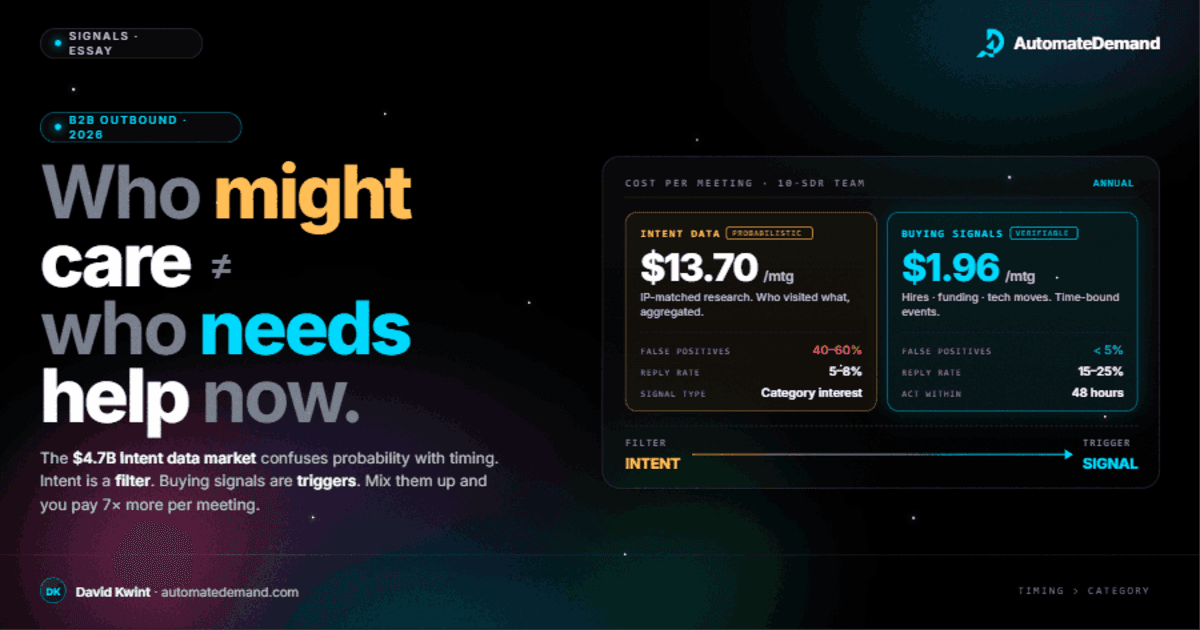
Intent data is probabilistic, tracking aggregate web activity to identify potential interest, while buying signals are specific, verifiable events like new hires or funding rounds. While intent data filters your market, buying signals act as triggers for outreach. Using signals increases reply rates from 5-8% to 15-25% by targeting the right timing.
Key Takeaways
Intent data should be used as a filter to narrow the addressable market rather than a direct trigger for sales outreach.
Real-time buying signals like new hires or funding rounds generate 15-25% reply rates compared to just 5-8% for intent-only targeting.
High-value signals decay quickly, with funding announcements losing 50% of their outreach value after just 30 days.
Intent Data vs Buying Signals: Why Most B2B Teams Confuse the Two
The intent data market hit $4.7 billion in 2026. Most companies paying into it see less than 2x ROI on their subscriptions. That's not a data problem. That's a definition problem.
B2B sales teams treat intent data and buying signals as the same thing. They're not. The difference between intent data vs buying signals is the difference between knowing someone browsed a car lot and knowing they just got approved for a loan. One is probabilistic. The other is actionable.
Here's the thing: intent data tells you WHO might be interested. Buying signals tell you WHEN someone needs help. Confusing the two costs pipeline, burns budget, and trains your team to distrust the data stack entirely.
What Intent Data Actually Is (And What It Isn't)
Intent data is aggregate and probabilistic. A vendor like Bombora tracks IP-matched web visits across their publisher network. When enough visits from one company cluster around a topic, that company gets flagged as "showing intent."
The pitch sounds good. "Company X is researching CRM software." But strip away the marketing and look at what's actually happening.
An IP address associated with a company visited three blog posts about CRM migration. Maybe it was the VP of Sales evaluating tools. Maybe it was an intern doing homework. Maybe it was someone on the guest WiFi at a co-working space.
Intent data has a 40-60% false positive rate. IP matching breaks when employees use VPNs, work from home, or share office buildings. Most intent data vendors sell the same underlying data. Bombora powers the majority of intent signals across dozens of resold platforms. You're paying five vendors for one dataset.
None of this means intent data is worthless. It means intent data is a filter, not a trigger.
What B2B Buying Signals Actually Look Like
Real-time buying signals are specific, observable, and time-bound. They don't require IP matching or probabilistic models. They're facts you can verify in five minutes.
Hiring signals. A company posts a VP of Sales role. That person has a 90-day mandate to build pipeline. The clock starts the day they accept the offer. By day 47, they're evaluating tools and partners. That's not a guess. That's organizational physics.
Funding signals. A Series B closes at $30M. The board expects an 18-month growth window. Marketing and sales budgets expand. New hires get approved. The company moves from "we should probably do outbound" to "we need outbound infrastructure yesterday."
Tech adoption signals. A company installs HubSpot. Three months later, they realize they need someone to actually run it. Or they rip out Salesforce and move to a new CRM. Both create immediate demand for operational help.
Executive changes. A new CRO joins from a company that used your exact category of tool. They already know what works. They're looking for the same stack at the new company.
Compliance pressure. A GDPR fine hits a company's sector. Their legal team mandates a data audit. Every vendor touching personal data gets scrutinized. If you sell compliance tooling, this is your moment.
The difference is specificity. Intent data says "this company might care about your category." A buying signal says "this company needs help with this problem, and the window is open right now."
The Math That Separates the Two
Numbers make this concrete.
Generic outbound (no signals, no intent): 3-5% reply rate. You're cold-calling into noise. Most messages get deleted unread.
Intent-data-only targeting: 5-8% reply rate. Better. You're at least reaching companies that showed some category interest. But you're still guessing at timing and pain.
Signal-personalized outreach: 15-25% reply rate. You're reaching the right person, at the right time, with a message that references something real happening in their business.
The math is simple. If your SDR sends 100 emails per day:
Generic: 3-5 replies. Maybe 1 meeting.
Intent-only: 5-8 replies. 2-3 meetings.
Signal-personalized: 15-25 replies. 5-8 meetings.
Same effort. Same headcount. 3-5x more pipeline from signals vs intent alone.
Signal Decay: The Hidden Variable
Here's what most teams miss. Real-time buying signals decay fast.
A funding announcement loses 50% of its outreach value after 30 days. By day 60, every sales tool on the planet has scraped that press release and dumped the company into automated sequences.
A job posting signal peaks at day 3-7. That's when the role is fresh, the hiring manager is actively thinking about the problem, and no one else has reached out yet. By day 30, the inbox is flooded.
This decay is why timing beats volume every time. Intent data refreshes weekly or monthly. Buying signals move in hours and days. If your system can't act on a signal within 48 hours, you've already lost the advantage.
Why Most B2B Teams Get This Wrong
The confusion comes from how tools are marketed. Intent data vendors call their product "buying signals." Signal platforms call themselves "intent tools." The terminology is deliberately blurred because it sells more subscriptions.
Here's a diagnostic. Ask your team these questions:
Can you name the specific event that triggered this outreach? (If the answer is "they showed intent," dig deeper.)
Can you verify this signal in under five minutes using public data?
Does this signal have a time-bound window of relevance?
If you can't answer all three, you're working with intent data, not buying signals. That's fine. But it changes how you should use the data.
The "Same Data, Different Wrapper" Problem
Most intent data vendors sell the same underlying dataset. Bombora's data cooperative feeds into dozens of platforms. G2 buyer intent gets resold through multiple channels.
You might be paying three vendors $30K each for what is essentially the same signal: "someone at this IP address visited content about your category." That's $90K for one data point with a 40-60% false positive rate.
Compare that to a $0 buying signal: go to LinkedIn, search for "VP Sales" with "started new position" in the last 90 days, filter by your target industry. That's a real signal. Verifiable. Time-bound. Free.
The Framework: Intent as Filter, Signals as Trigger
The winning play isn't choosing one over the other. It's layering them correctly.
Intent data = filter. Use it to narrow your total addressable market. If 10,000 companies fit your ICP, intent data can tell you which 2,000 are actively researching your category. That's useful for prioritization.
Buying signals = trigger. Within those 2,000 companies, find the ones with observable, time-bound events. New VP Sales hire. Recent funding. Tech stack change. Compliance pressure. These signals trigger personalized outreach.
Companies that layer buying signals on top of intent data see 3x higher conversion than intent-only approaches.
A Practical Example
Your ICP is mid-market SaaS companies with 100-500 employees. Here's how the framework plays out.
Step 1: Intent filter. Your intent data vendor flags 500 companies showing research activity around "outbound sales automation."
Step 2: Signal scan. You run those 500 companies through a signal detection layer. You find:
23 companies hired a new Head of Sales in the last 60 days
14 companies closed funding in the last 45 days
8 companies posted SDR/BDR roles in the last 14 days
Step 3: Prioritize by signal freshness. The 8 companies with fresh job postings get outreach today. The 14 recently funded companies get outreach this week. The 23 with new sales leaders get sequenced over the next two weeks.
Step 4: Personalize on the signal. Your message doesn't say "I noticed your company is interested in outbound tools." It says "I saw you're hiring 3 SDRs. Most teams at your stage burn the first 90 days figuring out the tech stack. Here's the playbook we built for companies scaling from founder-led sales."
That's the difference between 5% and 20% reply rates.
Building Your Signal Stack
A signal stack is the set of data sources and detection methods you use to identify buying signals in real time. Here's what a modern B2B signal stack looks like.
Tier 1: High-Value Signals (Act Within 48 Hours)
Signal | Source | Decay Rate |
|---|---|---|
Funding round | Crunchbase, press releases | 50% value loss at day 30 |
New executive hire | LinkedIn, job boards | Peaks day 3-7 of posting |
Tech stack change | BuiltWith, job postings | 2-4 week window |
Competitor contract expiry | G2 reviews, industry intel | Narrow renewal windows |
Tier 2: Medium-Value Signals (Act Within 2 Weeks)
Signal | Source | Decay Rate |
|---|---|---|
Expansion hiring (3+ roles) | LinkedIn, Indeed | 30-day relevance |
Office relocation/expansion | Press, commercial real estate | 60-day window |
Product launch | Press releases, Product Hunt | 2-3 week window |
Conference attendance | Event speaker lists | Pre-event: 2 weeks |
Tier 3: Context Signals (Use for Personalization)
Signal | Source | Decay Rate |
|---|---|---|
Podcast appearance | Apple, Spotify, YouTube | Low decay |
Blog post or LinkedIn content | Company blog, LinkedIn | 30-day relevance |
Award or recognition | Industry publications | Low decay |
Customer reviews (positive or negative) | G2, Capterra | 90-day relevance |
The best teams use Tier 1 signals as triggers, Tier 2 for sequence prioritization, and Tier 3 for message personalization.
The ROI Calculation Most Teams Skip
Let's do the math on a 10-person SDR team.
Intent-only approach:
Intent data subscription: $50K/year
100 emails/day per SDR = 1,000 emails/day
6% reply rate = 60 replies/day
25% meeting conversion = 15 meetings/day
Cost per meeting: $13.70 (intent data only, excluding SDR comp)
Signal-layered approach:
Signal tooling: $20K/year (many signals are free or near-free)
60 emails/day per SDR (fewer, more targeted) = 600 emails/day
20% reply rate = 120 replies/day
35% meeting conversion (better targeting = more qualified) = 42 meetings/day
Cost per meeting: $1.96
The signal-layered approach generates 2.8x more meetings at 86% lower cost per meeting. And the meetings convert better downstream because you reached the right person at the right time with relevant context.
That's the real answer to "is intent data worth it?" Intent data alone is marginal. Intent data plus buying signals is a multiplier.
How AI Changes the Signal Game
The reason this framework works better now than it did three years ago: agentic systems can monitor, detect, and act on signals at machine speed.
A human SDR can track maybe 50 accounts for buying signals. An agentic GTM system can monitor 10,000 accounts across LinkedIn, job boards, press releases, tech detection, and funding databases. When a signal fires, it routes to the right rep with full context.
The AI SDR debate misses this point. The value of AI in outbound isn't writing more emails. It's detecting more signals and routing them faster than any human team could.
Signal detection is where AI compounds. Every signal your system catches that a competitor misses is pipeline they'll never see.
What to Look For in Buying Signal Tools
If you're evaluating tools for intent-based outbound and signal detection, here's the checklist.
Signal freshness. Does the tool deliver signals in real time, or in weekly batches? Weekly is too slow for Tier 1 signals.
Signal specificity. Does it tell you "Company X is researching CRM" (intent) or "Company X just hired a VP RevOps from Salesforce" (signal)? Both are useful. Know which one you're getting.
False positive rate. Ask vendors directly about their IP-matching methodology. If they can't explain how they handle VPNs, remote work, and shared spaces, their data has holes.
Decay tracking. Does the tool show when a signal was first detected? A funding signal from 90 days ago is noise. You need timestamps.
Integration speed. How fast can a detected signal reach your outreach tool? If the answer is "export CSV, upload to CRM, build list, assign to rep," you've already lost the timing advantage.
According to Gartner's 2025 analysis, organizations that integrate real-time signals into their sales workflows see 2.3x higher win rates than those relying on batch intent data alone. And Forrester's B2B buying study confirms that 68% of B2B purchase decisions are influenced by timing-specific triggers, not general category research.
FAQ
What is the difference between intent data and buying signals?
Intent data is aggregate and probabilistic. It tracks patterns like website visits across IP-matched networks to infer that a company might be researching a topic. Buying signals are specific, verifiable events. A new VP Sales hire, a funding round, a job posting for 5 SDRs. Intent data tells you who might care. Buying signals tell you who needs help right now.
How do you use buying signals in B2B sales?
Monitor your target accounts for time-bound events: executive hires, funding rounds, tech stack changes, expansion hiring, compliance pressure. When a signal fires, reach out within 48 hours with a message that references the specific event. "I saw you just hired a Head of Revenue. Here's the playbook we built for companies making that transition." This approach hits 15-25% reply rates versus 3-5% for generic outbound.
Is intent data worth it?
Intent data alone delivers marginal returns. Most companies see less than 2x ROI on intent subscriptions, partly because 40-60% of signals are false positives from IP-matching issues. Intent data becomes worth it when used as a filter layer. Narrow your TAM with intent, then trigger outreach based on real buying signals. Companies using this layered approach see 3x higher conversion rates.
What are the best buying signal sources?
The best sources are free or low-cost. LinkedIn for executive changes and hiring patterns. Crunchbase or press monitoring for funding rounds. Job boards for expansion signals. BuiltWith or Wappalyzer for tech stack changes. G2 and Capterra for competitor dissatisfaction signals. The key is freshness. A signal detected within 48 hours is 3-5x more valuable than the same signal detected after 30 days.
How fast do buying signals lose value?
Signal decay varies by type. Funding announcements lose roughly 50% of outreach value after 30 days. Job posting signals peak at day 3-7. Executive change signals are strongest in the first 60 days of a new hire's tenure. Tech stack changes create 2-4 week windows. The universal rule: the faster you act on a signal, the higher your conversion rate.
Building a signal-based outbound system? We help B2B SaaS teams replace spray-and-pray with signal-triggered outreach that actually converts. No intent data subscriptions required. See how signal-based outbound works.
People Also Ask
What is the false positive rate of intent data?
Intent data typically has a 40-60% false positive rate because it relies on IP matching. This process often breaks when employees use VPNs, work from home, or share office buildings with other companies.
How does signal-personalized outreach affect reply rates?
Signal-personalized outreach can increase reply rates to 15-25%, significantly higher than the 5-8% seen with intent-only targeting. This is because the message references a specific, verifiable event happening within the prospect's business.
Why do buying signals decay so quickly?
Buying signals lose value as more competitors scrape the same public data and flood the prospect's inbox. For example, a funding announcement loses 50% of its value after 30 days as automated sequences saturate the lead.
How does AI improve B2B signal detection?
AI systems can monitor thousands of accounts across job boards, press releases, and tech databases simultaneously. This allows teams to detect and act on signals at machine speed, reaching prospects before the signal value decays.
FAQ
What is the main difference between intent data and buying signals?
Intent data is aggregate and probabilistic, identifying companies that might be researching a category based on web traffic. Buying signals are specific, verifiable facts like a $30M funding round or a new VP hire that indicate an immediate need for help.
How should sales teams layer intent and signals?
Teams should use intent data as a filter to identify the portion of their market actively researching a category. They should then use buying signals as the trigger to decide exactly when and why to reach out to specific accounts within that filtered list.
What are examples of Tier 1 buying signals?
Tier 1 signals include funding rounds, new executive hires, tech stack changes, and competitor contract expirations. These are high-value triggers that require action within 48 hours to maximize conversion rates before the window of relevance closes.
Is intent data worth the subscription cost?
Intent data alone often provides less than 2x ROI due to high false positive rates and generic targeting. However, it becomes a powerful multiplier when used to prioritize accounts that are then triggered by real-time buying signals, leading to 3x higher conversions.
When is the best time to act on a job posting signal?
A job posting signal peaks in value between days 3 and 7 after the role is posted. This is when the hiring manager is most focused on the problem and before their inbox becomes flooded by other sales teams.
How does timing impact B2B win rates?
According to Gartner, organizations that integrate real-time signals into their workflows see 2.3x higher win rates. Forrester also notes that 68% of B2B purchase decisions are influenced by specific timing triggers rather than general research.
TL;DR
Most B2B teams confuse probabilistic intent data with actionable buying signals, leading to low ROI and high false positives. By layering real-time triggers like executive changes or funding rounds over intent filters, sales teams can achieve 3x higher conversion rates and significantly lower costs per meeting.