AI Personalization in B2B Sales: The System Behind 1:1 Messaging at Scale
AI GTM
AI Personalization in B2B Sales: The 2026 System Guide
AI personalization in B2B sales is broken at most companies. Here is the system that hits 12% reply rates without sounding like a robot wrote it.
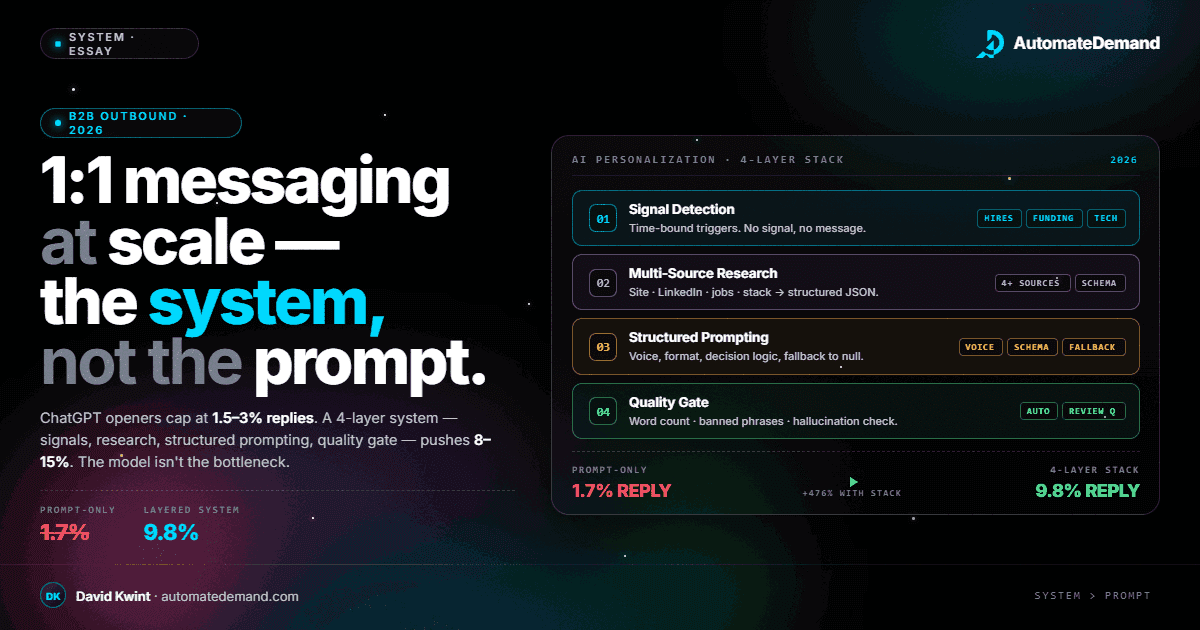
AI personalization in B2B sales is a research-driven system that generates role-specific and timing-specific messages at scale. By integrating signal detection, multi-source research, and structured prompting, it achieves 8-15% reply rates. This approach outperforms generic AI openers by grounding every message in verifiable data and strict voice constraints to ensure human-like quality.
Key Takeaways
Effective AI personalization requires a research-driven system rather than just better prompts or models.
A four-layer framework consisting of Signal Detection, Multi-Source Research, Structured Prompting, and Quality Gates is essential for Tier 3 results.
Voice calibration through banned-phrase lists and strict sentence-length constraints is critical to prevent identifiable AI-sounding output.
AI Personalization in B2B Sales: The System Behind 1:1 Messaging at Scale
The average B2B SDR sends 127 personalized emails per week, according to Bridge Group SDR benchmarks. Reply rates on those emails average 1.7%.
The math is brutal. 127 emails for two replies. Most of those replies are unsubscribes.
AI personalization in B2B promises to fix this. It does not, in most implementations. The teams running ChatGPT-generated openers see reply rates drop, not rise. The teams running structured AI personalization with the right inputs see 8-12% reply rates and three times the conversion to meeting.
The difference is not the model. It is the system around the model.
What AI Personalization in B2B Actually Means
AI personalization is the use of AI to generate role-specific, company-specific, and timing-specific message content at a volume no human can match.
The category breaks into three tiers.
Tier 1: Templated swap-ins. "Hi {{first_name}}, I noticed {{company}} just {{trigger}}." This is not AI personalization. It is mail-merge with extra steps. It scales but converts at firmographic baseline rates of 1-2%.
Tier 2: AI-generated openers. A model writes the first sentence based on a scraped LinkedIn bio or company website. Output reads like AI wrote it. Reply rates run 1.5-3%.
Tier 3: Research-driven AI personalization. Multiple data sources feed structured prompts that produce role-specific, signal-specific copy. Output is indistinguishable from human-written when the system is built right. Reply rates run 8-15%.
Most teams aim for Tier 3 and land at Tier 2. The gap is not the prompt. It is the data.
Why Most AI Personalization Fails
Three failure patterns account for 90% of broken AI personalization systems.
The thin-input problem. A prompt that says "write a personalized opener for this LinkedIn profile" with only a job title and company name produces generic output. The model has nothing to work with. It hallucinates. The opener reads like every other AI opener: "I noticed you are scaling [company]'s GTM motion."
The voice-collapse problem. Without explicit voice constraints, AI defaults to corporate-speak. Words like "leverage," "unlock," "synergy," and "game-changer" appear. The recipient knows immediately a model wrote it.
The verification problem. AI confidently outputs facts that are not true. "I saw your recent funding round" — when there was no funding round. "Congrats on the new product launch" — when there was no launch. One hallucinated fact destroys credibility for the entire campaign.
The model is not the bottleneck. Most teams hit the same 1.5-3% reply rate ceiling regardless of which model they use.
The fix is not a better prompt. It is a research layer that produces verifiable, role-relevant inputs before the model writes anything.
The 4-Layer System for AI Personalization
A working AI personalization system has four layers, executed in order.
Layer 1: Signal Detection
Before any message is generated, a signal must fire. Generic personalization wastes AI cycles on prospects who are not in a buying window.
The right signals are time-bound: a hire, a funding round, a product launch, a tech-stack change, a content publication. Each signal carries its own message angle. A new VP Sales gets a 90-day-mandate angle. A funding round gets a hiring-wave angle. A new tech install gets a stack-integration angle.
If you are sending AI-personalized messages without a signal layer, you are doing tier-2 work at tier-3 cost.
Layer 2: Multi-Source Research
For each prospect, pull data from at least four sources:
Company website — value proposition, recent news, customer logos
LinkedIn profile — career history, recent posts, mutual connections
Public signal sources — job postings, funding data, press releases
Tech stack data — current tools, recent installs, integrations
The research output is structured. Not a wall of text. A JSON-like object with named fields the prompt can reference: recent_hire, funding_stage, tech_stack, pain_indicators, relevant_post.
Signal-based outbound feeds this layer with the most predictive inputs.
Layer 3: Structured Prompting
The prompt is templated, not free-form. It takes the structured research output and produces copy in a constrained format.
A working prompt has six elements:
Voice constraints — list of words and phrases never to use
Format constraints — sentence length, paragraph count, opener style
Input variables — the structured research output
Decision logic — if signal X, then angle Y
Output schema — exact structure of the generated message
Fallback rule — what to do when input data is thin (return null, not garbage)
The fallback rule matters most. A system that returns null on thin data sends 30% fewer messages but lifts reply rates 3-5x because every sent message is grounded in real data.
Layer 4: Quality Gate
Before any AI-generated message ships, it passes a check.
Three automated checks catch 80% of failures: word count within range, no banned phrases, no hallucinated facts (verified against the research output). Anything that fails routes to a human review queue. Anything that passes ships.
The gate is not optional. Without it, hallucinations leak into production. Reply rates collapse the day a "congrats on the funding round" goes to a company that did not raise.
The Math Behind AI Personalization ROI
The case for AI personalization is not "more emails." It is "better emails at scalable volume."
Compare a 5-rep SDR team running manual personalization vs. the same team running AI personalization with a research layer:
Metric | Manual personalization | AI personalization |
|---|---|---|
Emails per rep per week | 80 | 240 |
Time per email | 8 minutes | 2 minutes |
Reply rate | 6.5% | 9.8% |
Replies per rep per week | 5.2 | 23.5 |
Meetings per rep per week | 1.4 | 6.1 |
Total team meetings/month | 28 | 122 |
The lift is 4.4x meetings per month. The cost is the AI tooling and the system build, which together run roughly 8% of the team's loaded cost.
The 10th personalized message should take 1/10th the time of the first. If it does not, you have built a workflow, not a system.
This is where agentic GTM systems earn their place in the budget. The compounding value of a working AI personalization layer is not measurable in any single campaign. It shows up in the cost-per-meeting trend over six months.
Voice Calibration: The Hardest Part
Most teams underestimate voice calibration. They assume the model defaults are acceptable. They are not.
A model's default voice is the average of its training data. The average is corporate sales-speak. To get output that does not sound like AI, the system must explicitly forbid the voice it would otherwise produce.
A working voice calibration layer has three components:
Banned-phrase list. Words the model is told never to use. Common entries: leverage, unlock, synergy, optimize, game-changer, cutting-edge, revolutionary. Also common AI tells: "It is worth noting," "In today's landscape," "I hope this email finds you well."
Style examples. Three to five sample messages in the target voice, included in the prompt. The model imitates what it sees. Show it short, declarative, data-first sentences and that is what it writes.
Sentence-length constraint. Maximum 18 words per sentence. Average 12-14. This single constraint kills 60% of the AI-sounding output, because long winding sentences are the strongest AI tell.
Cold email personalization at scale lives or dies on voice calibration. Get it wrong and the volume amplifies the problem.
What AI Personalization Cannot Do
AI personalization is not a replacement for strategy. Three things it cannot do:
It cannot fix bad targeting. Personalizing a message to a prospect who is not in your ICP wastes AI cycles. The prerequisite to AI personalization is a clean, scored target list.
It cannot fix a weak offer. A perfectly personalized email that pitches a tool the prospect does not need fails. Personalization amplifies the offer; it does not replace it.
It cannot fix bad timing. Sending an AI-personalized message to a VP Sales on day 423 of their tenure converts the same as a generic message. The signal layer is not optional.
The teams that succeed with AI personalization treat it as a force multiplier on a working GTM motion. The teams that fail treat it as a substitute for one.
Building the System: 60-Day Implementation Plan
A real AI personalization system takes 60 days to build and 90 days to tune.
Days 1-15: Signal layer. Set up signal detection for 3-5 trigger types relevant to your ICP. Hiring signals, funding rounds, tech installs are the most common starting points.
Days 16-30: Research layer. Build the multi-source enrichment that produces structured output for each detected signal. Clay, Apollo, and direct API integrations cover most use cases.
Days 31-45: Prompt and quality gate. Develop the structured prompt with voice constraints, fallback rules, and output schema. Build the automated quality checks that catch hallucinations and banned phrases.
Days 46-60: Pilot. Run the system on 200-500 prospects across 2-3 campaigns. Measure reply rates against your manual baseline. Tune the prompt, the research inputs, and the gate.
Days 61-90: Scale. Expand to full SDR team usage. Track cost-per-meeting. Iterate on the lowest-converting signal types.
By month 4, the system should be delivering 30-50% of total outbound pipeline at 2-3x the conversion rate of manual personalization.
FAQ: AI Personalization in B2B Sales
What is AI personalization in B2B sales? AI personalization uses machine learning models to generate role-specific, company-specific, and timing-specific message content at scale. The most effective implementations combine signal detection, multi-source research, structured prompting, and a quality gate. Output reply rates run 8-15% versus 1-3% for templated personalization.
Does AI personalization actually work? Yes, when built as a system. Standalone AI tools that generate openers from a LinkedIn URL produce 1.5-3% reply rates. Full AI personalization systems with signal detection and research layers produce 8-15% reply rates and 3-5x the meeting conversion.
How is AI personalization different from mail-merge? Mail-merge swaps variables into a static template. AI personalization generates new content for each prospect based on structured research data. The output is a different message for every recipient, written to match a specific signal and angle.
What tools are needed for AI personalization at scale? A typical stack includes a data enrichment platform (Clay, Apollo), a signal detection layer (job posting APIs, funding databases), an LLM API (Claude, GPT), and a sequencing tool (Instantly, Smartlead, Outreach). The total monthly cost for a 5-rep team runs $1,500-$3,000.
How do you prevent AI from hallucinating in personalized emails? Constrain the model to use only verified facts from the research layer. Implement a quality gate that cross-checks generated content against source data. Use a fallback rule that returns null instead of generating content when input data is thin.
Can AI personalization replace human SDRs? No. AI personalization replaces the manual research and writing portions of the SDR job. Strategy, account prioritization, complex objection handling, and human-to-human selling still require humans. The right model is human-in-the-loop, not human-replaced.
Next Step
AI personalization is not a tool you buy. It is a system you build.
The 4-layer framework above is the operating model. The 60-day plan is the build sequence. The math is what justifies the investment.
If you want a worked example of an AI personalization system for your specific ICP, send me your top 50 target accounts and your current cold email template. I will return a sample week of AI-personalized output with reply-rate predictions. No call required.
The right time to start is before your competitor figures this out.
People Also Ask
How does AI personalization improve B2B reply rates?
It moves from generic templates with 1-2% rates to research-driven, signal-specific content that achieves 8-15% reply rates. By grounding messages in verifiable data and specific timing, the output becomes indistinguishable from human-written copy.
What are the common failures in AI personalization?
Most systems fail due to thin inputs that lead to hallucinations, 'voice collapse' into corporate-speak, and a lack of verification. These issues result in generic openers or false claims that destroy sender credibility.
What is the 4-layer system for AI personalization?
The system consists of Signal Detection for timing, Multi-Source Research for data gathering, Structured Prompting for message generation, and a Quality Gate for verification. This sequence ensures messages are relevant, accurate, and properly formatted.
How much does an AI personalization system cost?
For a five-rep team, the tooling and system build typically cost between $1,500 and $3,000 per month. This investment represents approximately 8% of the team's loaded cost while delivering a significant lift in meetings.
FAQ
What is Tier 3 AI personalization?
Tier 3 is research-driven personalization where multiple data sources feed structured prompts to produce role-specific and signal-specific copy. This output is indistinguishable from human writing and yields 8-15% reply rates compared to lower tiers.
How do you stop AI from sounding like a robot?
You must implement voice calibration by banning corporate-speak like 'leverage' or 'synergy' and providing style examples. Enforcing a maximum sentence length of 18 words also eliminates the long, winding sentences typical of AI output.
What is the 'fallback rule' in prompting?
The fallback rule instructs the system to return null instead of generating garbage when input data is thin. This prevents hallucinations and ensures that every sent message is grounded in real, verifiable data.
Can AI personalization fix a bad sales strategy?
No, it cannot fix poor targeting, a weak offer, or bad timing. AI personalization acts as a force multiplier for a working GTM motion rather than a substitute for a solid strategy.
What tools are required for this system?
A standard stack includes data enrichment platforms like Clay or Apollo, signal detection APIs, and LLM APIs like Claude or GPT. These are integrated with sequencing tools like Instantly or Outreach to deliver messages.
What is the ROI of switching to AI personalization?
A five-rep team can increase total monthly meetings from 28 to 122, representing a 4.4x lift. This is achieved by reducing the time spent per email from 8 minutes to 2 minutes while increasing reply rates.
TL;DR
AI personalization succeeds only when built as a four-layer system involving signal detection, multi-source research, structured prompting, and quality gates. This methodology moves beyond generic AI openers to achieve 8-15% reply rates and a 4.4x increase in meetings.