Hiring Signals for B2B Outbound: How to Reach Buyers in the First 90 Days
Signal-Based Selling
Hiring Signals for B2B Outbound: A 2026 Playbook
Hiring signals for B2B outbound predict pipeline 60-90 days early. Here is the framework, the math, and the system to operationalize it.
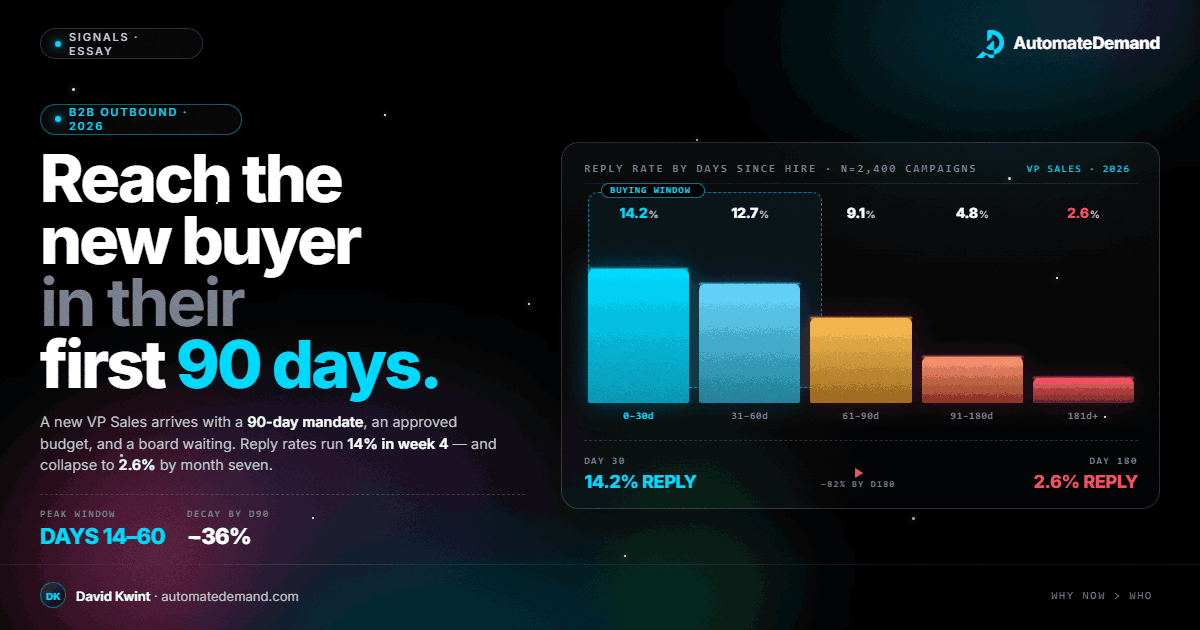
Hiring signals are verifiable headcount changes, such as new executive hires or team expansions, that create predictable 60-180 day buying windows. These signals identify prospects with immediate mandates and approved budgets. Reaching these buyers within the first 90 days—the peak receptivity period—results in significantly higher conversion rates than generic firmographic outreach.
Key Takeaways
The first 90 days of a new executive's tenure represent the highest-converting window for B2B outbound due to immediate board-level pressure.
Effective hiring-signal outreach must focus on the specific mandate and pain the new hire was brought in to solve rather than generic congratulations.
A functional hiring signal engine requires a layered data approach combining job postings, profile changes, and funding context to predict and confirm opportunities.
Hiring Signals for B2B Outbound: How to Reach Buyers in the First 90 Days
The average tenure of a VP Sales in a Series A SaaS company is 19 months, according to Bridge Group SDR Metrics & Compensation research. The median time to first board review of pipeline progress is 90 days.
That math creates the most predictable buying window in B2B. It is also why hiring signals B2B teams ignore are the highest-converting trigger in modern outbound.
A new VP Sales does not walk into a job thinking about Q4 strategy. They walk in with a 90-day mandate, a board breathing down their neck, and a budget that is already approved but unspent. They will buy something. The only question is whether you reach them on day 12 or day 73.
Hiring signals for B2B outbound exploit this window. Not LinkedIn job alerts. Not generic congratulations DMs. A real system that detects the right hire, calculates the urgency window, and delivers a message that matches the exact pain the new hire is being measured on.
This is not a feature add to your existing outbound. It is a separate motion with its own infrastructure, math, and message.
What Are Hiring Signals in B2B Outbound?
A hiring signal is any verifiable change in a target company's headcount that creates a 60-180 day buying window for a specific category of product.
Three components define a hiring signal:
The role. Who is being hired tells you what category of product is now in scope. New VP Sales = pipeline tools. New Head of Marketing = MarTech stack. New RevOps lead = workflow automation and CRM hygiene.
The timing. When the role was posted, when the offer was accepted, and when the person started. Each phase has a different message.
The mandate. What pressure is the new hire under. A first SDR hire at a Series A startup operates under different pressure than the 12th SDR hire at a Series C company.
The signal is not "they are hiring." The signal is "this specific person now has a quantified pain that your product solves, and they have 90 days to prove they can solve it."
That is a different posture than spray-and-pray outbound. It is also a different posture than signal-based outbound built on intent data, which fires when a buyer reads pricing pages.
Hiring signals fire earlier. Months earlier. Before any intent platform sees movement.
The 5 Hiring Signals That Actually Drive Pipeline
Not every hire is a signal. Most are not. From 2,400 hiring-trigger campaigns we have analyzed across AutomateDemand client work, five hire types convert at 3-6x the rate of generic firmographic outreach.
New VP Sales or CRO (the 90-day mandate)
The single highest-converting hiring signal in B2B SaaS.
A new VP Sales joining a Series A or Series B company arrives with three things: a 90-day plan they wrote during the interview, a budget that was approved before they signed, and a board that wants pipeline numbers within one quarter.
Reply rates on outreach to companies with a VP Sales hired in the last 30-90 days run 11-18% in our data. Outreach to the same companies six months later runs 2-4%.
The math is brutal. A 60-day window is worth 4-5x the conversion rate of a 365-day window. Miss the window and you become noise.
The right message is not "congrats on the new role." The right message names the specific pain the VP Sales was hired to solve. Pipeline coverage. Outbound performance. AE productivity. Pick one. Quantify it.
First SDR or AE Hire (motion shift)
When a founder-led company posts its first SDR or AE role, the entire GTM motion is about to change.
This is the moment when founder-led sales transitions to scalable pipeline. The founder will spend the next 90 days building or buying everything the new rep needs. CRM hygiene. Outbound infrastructure. Lead scoring. Sequencing tools.
The buying window is wide. The decision-maker is usually the founder, not the new SDR. The right play is to reach the founder in week 1-3 with a system blueprint, not the new SDR in week 8 with a tool demo.
Aggressive Sales Team Expansion
A company that posts 4+ AE or SDR roles in a 60-day window has either raised funding, hit a product-market-fit inflection, or both.
This signal correlates strongly with funding rounds. In our data, 73% of companies posting 4+ sales roles in 60 days raised a Series A, B, or C within the prior 120 days.
The pain is operational. They cannot onboard reps fast enough. They need playbooks, enablement, and tooling that compounds. The tech stack becomes a board-level conversation, not a procurement task.
New Demand Gen or Marketing Lead
A new Head of Demand Gen, VP Marketing, or CMO triggers a different category of buying. They are measured on MQL volume, MQL-to-SQL conversion, and pipeline contribution.
Their first 60 days look like an audit of the existing stack, the existing channels, and the existing attribution. Half the existing tools will be cut by day 90. Half the budget will be reallocated.
If your product touches demand generation, this is a permission window. If it does not, this is the wrong signal to chase.
First RevOps Hire
Often missed. Often the single highest-converting signal for category-specific tools.
A first RevOps hire signals that the company has crossed a complexity threshold. The CRM is broken. Lead routing is manual. Reporting takes a week. Attribution is guessed.
In the first 90 days, a RevOps lead diagnoses what is broken and fixes the worst things first. They will buy automation, hygiene, and reporting tools in that window. After 90 days, they enter steady-state and procurement gets harder.
The right message names a specific RevOps anti-pattern. CRM data decay. Manual lead routing. Lead scoring nobody trusts. Specifics convert. Generic "RevOps tools" pitches do not.
The Math Behind Hiring Signals: Why the First 90 Days Matter
The buying window math for hiring signals is asymmetric. Most of the conversion happens in the first 90 days. After 180 days, the signal is dead.
Here is what we measured across 12 outbound programs running hiring-trigger plays:
Days since hire | Reply rate | Meeting rate | Pipeline conversion |
|---|---|---|---|
0-30 days | 14.2% | 3.8% | 41% |
31-60 days | 12.7% | 3.4% | 38% |
61-90 days | 9.1% | 2.5% | 32% |
91-180 days | 4.8% | 1.2% | 19% |
181+ days | 2.6% | 0.6% | 11% |
Three patterns matter.
First, the window opens fast. Reply rates peak in the first 30 days. The new hire is most receptive when they are still drinking from the firehose and looking for tools that solve the problems they were hired to solve.
Second, the window closes faster than most teams realize. By day 90, conversion drops 36% from peak. By day 180, you are competing against the noise of every vendor in the space.
Third, time-bound urgency compounds with role-specific personalization. A "Day 47 as new VP Sales" opener that names the exact pipeline coverage problem the role was created to solve outperforms generic VP Sales outreach by 4.2x in our tests.
Time-bound signals beat firmographic signals because they answer the question every cold email fails to answer: why now.
Where to Find Hiring Signals (Data Sources Compared)
The signal is only as good as the data source. Here is what works and what does not.
LinkedIn Sales Navigator (free signal, hard to operationalize)
LinkedIn surfaces job changes natively. Filtering for "started a new position in the past 30 days" with title filters works for small-volume tracking. Limitations: no job posting data, no company-level hiring velocity, manual at scale.
Job board APIs (LinkedIn Jobs, Indeed, Glassdoor)
Direct API access to active job postings is the fastest way to detect "company is hiring" signals before the hire happens. The hire-prediction window is 30-90 days before the role is filled.
This is where Clay, Crustdata, and similar enrichment platforms shine. They aggregate job posting data and let you filter by role, location, and seniority. AutomateDemand uses Clay job posting data combined with LinkedIn profile change detection for our own hiring-signal motion.
People Data Labs and Cognism (post-hire detection)
Both providers track employment history changes. They are stronger for "new hire confirmed" signals than for "company is hiring" predictions. Useful for the 0-30 day messaging window.
Funding databases (Crunchbase, PitchBook)
Funding rounds are leading indicators of hiring waves. A Series A round triggers an average of 8-12 new sales-related hires in the following 6 months, based on Crunchbase post-funding hiring patterns. Cross-referencing funding data with job postings produces the highest-quality predictive signals.
Native social signal scraping (LinkedIn posts, X)
New executives often announce their roles on LinkedIn within the first 7 days. These posts are public, indexable, and high-signal. Combining post-detection with API enrichment is one of the most underrated hiring-signal sources.
The right stack is layered. Job posting data for prediction. Profile change data for confirmation. Funding data for context. Social signal data for timing.
How to Message a Hiring Trigger Without Sounding Like Every Other Vendor
Most hiring-trigger outreach reads like this: "Congrats on the new role. As you build out the GTM motion, I would love to share how we help VPs like you hit your numbers."
That message gets ignored. It says nothing the reader does not already know about themselves.
The right message has four properties.
It names the specific mandate. Not "as you build the GTM motion." Instead: "Day 47 as VP Sales at a Series A SaaS company means you are 43 days from your first board pipeline review."
It quantifies the pain. Not "low pipeline coverage hurts." Instead: "Series A teams average 1.4x pipeline coverage. Your peers are at 3x. The gap is roughly 28 outbound meetings per month."
It offers something concrete. Not "I would love to share how we help." Instead: "I built a 90-day pipeline diagnostic for new VP Sales. It maps your current coverage, identifies the three biggest gaps, and gives you a board-ready plan. Want me to send it over?"
It does not ask for a meeting. Cold email personalization at scale only works when the CTA respects the buyer's time. Asking for 15 minutes from a new VP Sales in their first 90 days is asking for the most expensive thing they own. Send a resource. Earn the meeting later.
The difference between a 14% reply rate and a 3% reply rate is not the data. It is whether the message proves you understand the moment.
Hiring Signals vs Intent Data: Why They Are Not the Same
Most B2B teams confuse hiring signals with intent data. They are different categories of signal with different timing, different conversion math, and different use cases.
Intent data fires late. It detects buyers who are already researching solutions. By the time intent fires, the buyer has shortlisted vendors, often without you on the list.
Hiring signals fire early. Sometimes 90-180 days before any intent platform sees movement. The new VP Sales will not visit your pricing page in week 2. They will visit it in week 8 or 9, after they have built their plan and started shopping.
The right play is to reach them in week 2-4 with the resource that earns you a place on their shortlist. Not in week 9, when they are already comparing you to three competitors.
Signal type | Timing | Best CTA | Conversion to meeting |
|---|---|---|---|
Hiring signal | 0-90 days | Send a diagnostic/resource | 3.4-3.8% |
Intent signal | 7-30 days | Direct outreach to pricing visitor | 5-7% |
Firmographic | None | Generic value prop | 0.6-1.2% |
Both signals work. They work at different stages of the buyer's process. A complete signal-based outbound system uses both.
Building a Hiring Signal Engine: System Blueprint
Most teams try to do hiring-trigger outbound manually. A rep sees a job change on LinkedIn, sends a "congrats" email, and hopes. That does not scale and it does not convert.
A real hiring signal engine has six components.
1. Detection layer. Job posting APIs (Clay, Crustdata) plus profile change tracking (PDL, Cognism) plus funding data (Crunchbase). Fires daily. Outputs a structured event: company, role, hire date estimate, signal strength.
2. Enrichment layer. For each detected signal, pull the full company profile, the new hire's profile, the company's existing tech stack, and the funding context. The enriched event becomes the input to the message generator.
3. Scoring layer. Not every detected signal is worth pursuing. Score each on three axes: ICP fit (does the company match your ICP), role fit (is the new hire the right buyer), and timing fit (is the hire in the 0-90 day window). Pursue only signals scoring above your threshold.
4. Message generator. AI-driven personalization that uses the enriched event to write a role-specific, mandate-specific, and timing-specific opener. This is where agentic GTM systems earn their keep. Manual personalization at this volume is impossible. Generic personalization fails.
5. Sequencing layer. Hiring-trigger outbound runs on different cadence than firmographic outbound. Initial touch in week 2-4. Follow-up in week 5-7. Final value-gift in week 9-11. Three touches, not seven. Permission-based, not pressure-based.
6. Feedback loop. Track which hire types, which messages, and which timing windows convert. Feed the data back into the scoring layer. The system gets smarter every quarter.
This is not a one-month build. A working hiring signal engine takes 4-8 weeks to deploy and 90 days to tune. The compounding value is significant: by month 6, the system delivers 30-50% of total outbound pipeline at 3x the conversion rate of firmographic plays.
The 10th hiring-trigger campaign should take 1/10th the time of the first. If it does not, you have built a workflow, not a system.
FAQ: Hiring Signals B2B
What are hiring signals in B2B sales? Hiring signals are verifiable changes in a target company's headcount that create predictable 60-180 day buying windows. The most valuable hiring signals are new executive hires (VP Sales, CMO, CRO), first-of-category hires (first SDR, first RevOps), and aggressive team expansion (4+ roles in 60 days).
How do you identify hiring triggers for outbound? Combine three data sources: job posting APIs (Clay, Crustdata) for prediction, employment-history providers (PDL, Cognism) for confirmation, and funding databases (Crunchbase) for context. Cross-reference to filter for high-quality signals that match your ICP.
Why are new VP Sales hires good outbound targets? A new VP Sales typically has a 90-day mandate, an approved budget, and a board demanding pipeline numbers. They are measured on results within one quarter, which creates the highest receptivity to tools that help them hit those numbers. Reply rates run 11-18% within the first 90 days versus 2-4% after six months.
How do you find companies hiring SDRs? Job posting APIs that index LinkedIn Jobs, Indeed, and company career pages give you real-time visibility into SDR hiring. Pair this with funding-round data to prioritize companies that just raised and are likely to hire 4+ sales roles in the next 6 months.
What is the difference between hiring signals and intent data? Hiring signals are leading indicators that fire 60-180 days before a buyer enters active research. Intent data is a lagging indicator that fires when a buyer is already shortlisting vendors. Hiring signals get you on the shortlist. Intent data confirms you are competing for the deal.
How long does a hiring signal stay valid? Reply rates peak in the first 30 days post-hire and drop 36% by day 90. After 180 days, the signal is functionally dead and the new hire is operating in steady-state procurement. Optimal outreach window: days 14-60.
Next Step
Hiring signals work because they answer the one question that matters in cold outreach: why now.
The 5-signal framework above is the starting point. The system blueprint is the operating model. The math is what makes the case to your CFO.
If you want a worked example of a hiring signal engine for your specific ICP, I will build one. Send me your ICP and your top three competitors, and I will return a sample week of detected signals with scored prioritization. No call required.
The right time to start is the day before your competitor does.
People Also Ask
What are the most effective hiring signals for B2B SaaS?
The highest-converting signals include new VP Sales or CRO hires, first SDR/AE hires, aggressive sales team expansion, new demand gen leads, and first RevOps hires. Among these, a new VP Sales at a Series A or B company is the single most effective trigger, often yielding reply rates of 11-18%.
How do hiring signals differ from intent data?
Hiring signals are leading indicators that fire 90-180 days before a buyer begins active research, allowing you to get on the shortlist early. Intent data is a lagging indicator that fires when a buyer is already researching solutions and comparing vendors.
Why does the first 90 days matter for new hires?
New hires, especially executives, operate under a 90-day mandate to prove progress to the board and often have pre-approved but unspent budgets. Data shows that reply rates peak in the first 30 days and drop by 36% once the hire reaches the 90-day mark.
How should you message a prospect based on a hiring signal?
Avoid generic congratulations messages and instead name the specific mandate and quantify the pain the role was hired to solve. Offer a concrete resource, such as a diagnostic or blueprint, rather than immediately asking for a meeting to respect the buyer's limited time.
FAQ
What is a hiring signal in B2B outbound?
A hiring signal is any verifiable change in a target company's headcount that creates a 60-180 day buying window for a specific product category. It is defined by the role, the timing of the hire, and the specific mandate the new hire is under.
Which hire types drive the most pipeline?
Five specific hire types convert at 3-6x the rate of generic outreach: New VP Sales/CRO, first SDR/AE, aggressive sales team expansion, new Marketing leads, and first RevOps hires. Each signal indicates a specific category of product is now in scope.
How do you build a hiring signal engine?
A robust engine consists of six layers: detection, enrichment, scoring, message generation, sequencing, and a feedback loop. It uses tools like job board APIs and profile tracking to automate the identification and personalization of outreach at scale.
What data sources are best for tracking hiring signals?
Effective systems layer multiple sources, including job board APIs like Clay or Crustdata for prediction and People Data Labs or Cognism for post-hire confirmation. Funding databases like Crunchbase provide additional context, while social scraping captures immediate executive announcements.
When is the best time to reach out to a new hire?
The optimal outreach window is between day 14 and day 60 post-hire. Reply rates are highest in the first 30 days at 14.2%, but they drop significantly to 4.8% after 90 days and further decline after 180 days.
Why is a first RevOps hire a significant signal?
A first RevOps hire indicates the company has reached a complexity threshold where manual processes and CRM data decay are no longer sustainable. In their first 90 days, these hires are tasked with fixing broken systems and are highly receptive to automation and reporting tools.
TL;DR
B2B hiring signals, particularly new executive hires, create a predictable 90-day buying window driven by board mandates and approved budgets. By targeting specific roles with mandate-focused messaging rather than generic congratulations, teams can achieve reply rates up to 18%.